A bedside cabinet can look lighter without being attached to the wall. The NSP-FL01 floating-look smart nightstand uses a recessed connection between an upper box and a lower cabinet to create a layered silhouette. The base remains on the floor. That distinction is central to its appeal: buyers get a visually separated form rather than the continuous front of a conventional cabinet, while retaining a floor-standing furniture format.
For importers, bedroom-furniture retailers and private-label teams, FL01 is worth considering as a design-led smart model within an existing assortment. Its reference dimensions are W50 x D40 x H62 cm. The listed functions include LED accent lighting, a wireless-charging top and a lower safe-storage compartment. The product story should begin with its distinctive shape, then explain the configuration that supports everyday use.
The recessed waist is the defining design detail
The upper section appears separate because the connection below it is set back from the front and sides. In the reference image, this recess creates a horizontal shadow line above the lower block. The result is a stacked, floating-look composition, not an unsupported cabinet and not a wall-mounted nightstand.
This gives a retailer a clear reason to show FL01 alongside a simpler straight-front model. The customer is choosing a different visual rhythm at the bedside, rather than merely a different handle. Photograph the cabinet from a three-quarter angle with its base visible so the layered connection and floor contact are understandable. A tight image that hides the lower edge could accidentally suggest an installation method the product does not use.
The design also rewards careful sample inspection. Look at whether the recessed line is even across the front, whether the upper section is aligned with the lower body, and whether visible edges remain consistent from both sides. These are the details that carry the appearance; extra decorative props cannot compensate for a poorly aligned sample.
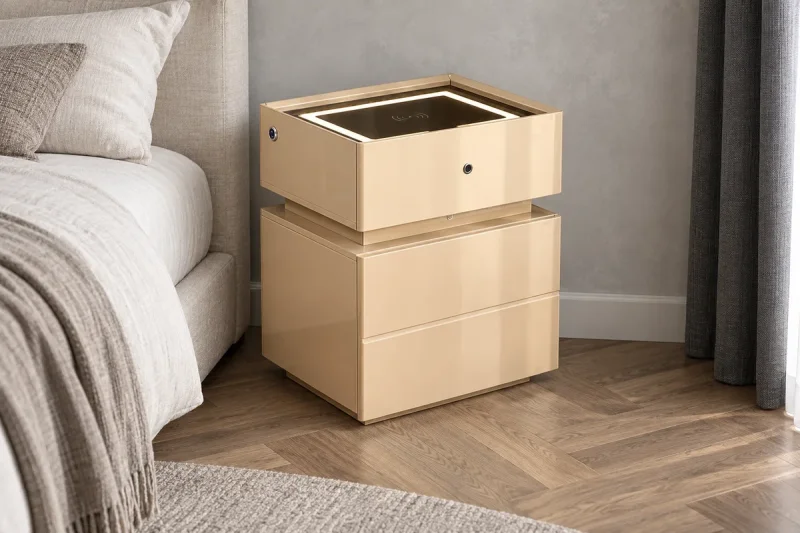
AI-assisted room illustration based on the FL01 product reference. The room is illustrative; supplied colours, materials and functions follow the approved sample and order specification.
Plan a floor-standing bedside position
The 50 cm width gives FL01 a defined place in a bedroom range, but a room plan still needs the actual bed, headboard and socket positions. Check the 62 cm reference height against the top of the mattress and the user's reach. Compare the 40 cm depth with the headboard projection, skirting board and bedside passage before choosing a placement.
The recessed waist is not clearance underneath the furniture. Do not describe it as providing open floor space for a robot vacuum or the cleaning access of a wall-hung unit. Plan cleaning around the base and the recessed surfaces themselves. Review the placement and any restraint requirements using the approved product instructions rather than assuming that floor-standing means no installation review is needed.
For hotel and serviced-apartment rooms, test a representative room arrangement with bedding, curtains and bedside lighting in place. Confirm that storage can be opened, power connections remain accessible for service and the cabinet does not interfere with the intended passage around the bed.
A clean front needs an equally clear storage explanation
The reference presents an upper box with a small round inset detail and a lower section with two broad front panels. Those visible divisions should not be converted automatically into a drawer-count claim. The specification includes lower safe storage, so request an internal layout showing which sections open, how they operate and how much usable space each provides.
For a reseller, that layout becomes the basis of accurate product bullets and customer instructions. For a project buyer, it helps establish whether the storage fits the intended belongings and whether access is practical beside the chosen bed. Confirm the function of the small control details from the sample; their appearance alone is not enough to identify fingerprint access, a particular lock type or a specific sensor function.
Safe storage should have its own agreed locking method, instructions and support procedure. Do not infer a tested security rating from the presence of a lockable compartment. Where many rooms share one model, discuss access recovery and replacement parts before an order is placed.
Let the top panel support the design, not dominate the claims
The dark inset top panel contrasts with the pale cabinet shown in the reference, while the illuminated border reinforces the upper box. The product specification describes an MDF cabinet body, a glass-look top panel and LED accent lighting. Approve the actual panel material and finish rather than substituting claims about stone, tempered glass or solid wood.
Review the light in both daylight and a dim room. Ask which lighting controls and modes are included in the selected configuration and whether it can be switched off independently. Brightness, colour temperature and automatic activation should be documented if they are part of the order; none should be invented from a lit product photograph.
Wireless charging also needs a defined module and power supply. Confirm device compatibility, output, adapter and plug requirements, then test the intended devices and cases on the sample. Keep the charging area clear in sales photography unless the illustrated device and placement have been checked. An appealing glowing top is not proof of universal phone compatibility.
Approve a coordinated finish for the first assortment
FL01 is listed with White, Grey and Black options. The warm tone of a reference photograph should not replace a physical colour sample. Gloss, lighting and surrounding materials can change how a finish appears, particularly on broad reflective panels. Use the selected sample code, not a screen colour, as the reference for purchase approval.
Our nightstand materials and finish guide helps frame that discussion. For FL01, assess the body, recessed connection, panel edges and top insert together. Confirm the cleaning instructions for those surfaces and check the consistency of visible joints, because the simple front leaves them exposed rather than hidden by decorative handles.
As a first-order strategy, a focused finish and feature combination is easier to demonstrate and support than a wide collection of almost identical variants. The smart-nightstand assortment planning guide can help place a design-led model like FL01 alongside products serving different storage or room-size needs.
Turn the layered form into repeatable quality checks
The upper box, connecting section and lower body should be evaluated as one assembled unit. During sample approval, check alignment, stability in the intended placement, access to storage, cable routing and each specified electronic function. Avoid treating the recessed waist as a lifting handle unless the handling instructions explicitly allow it.
Packaging should protect the top insert, projecting edges and finished surfaces without placing damaging pressure on the recessed section. Agree how the unit is handled, how loose accessories are secured and what assembly is required on arrival. Final carton dimensions and loading calculations should correspond to the approved packing configuration.
Use the pre-shipment quality checklist as a starting point, then add checks for the evenness of the layered gap, lighting operation, charging and the agreed storage mechanism. Record the accepted sample so repeat orders can be compared against the same visual and functional standard.
Who should shortlist FL01?
FL01 suits a buying brief that seeks a distinctive layered bedside silhouette with smart functions in a floor-standing format. It is not the appropriate substitute when a project specifically requires wall mounting, an open floor underneath or a conventional vanity workspace. Stating those boundaries makes the recommendation more useful and reduces mismatched enquiries.
For an OEM or private-label quotation, provide the NSP-FL01 reference, destination market, quantity, chosen finish and intended retail or project use. Add the charging, lighting, locking and packaging requirements to be reviewed. The goal is a recognisable model with an agreed specification, not a list of optional features that changes between the sample, the listing and the shipment.