A decorative bedside cabinet has to work as a useful piece of furniture as well as an eye-catching image. The Panda Decorative Storage Nightstand ZG08 combines a white upholstered exterior with a distinctive panda-and-bamboo design across its front. For retailers, importers and private-label buyers, it is a candidate for a themed bedroom range where visual consistency matters as much as the cabinet footprint.
The reference specification lists a fiberboard frame, microfiber-leather upholstered exterior, white finish and a depth and height of 40 and 47 cm respectively. Listed width options range from 20 to 50 cm. These are reference dimensions: confirm the selected width, construction and the exact appearance of its front panels with the supplier and an approved sample. The picture does not establish which size is shown.
Where a character-led cabinet can fit in an assortment
A recognisable design can give a specialty bedroom collection a clear visual identity. A retailer might present ZG08 as a focal bedside piece alongside neutral bedding and coordinated white storage. An importer may instead test a small decorative range alongside more conventional upholstered models. In both cases, the buying decision should account for actual customer demand, space available and the way the product will be photographed and displayed.
For hospitality or family-room projects, check whether the theme suits the property and whether the selected cabinet leaves sufficient clearance beside the bed. A panda motif alone does not establish that a product meets children's furniture or toy safety requirements. Where the intended market or use has specific rules, agree the relevant tests and documentation for the exact configuration before placing an order.
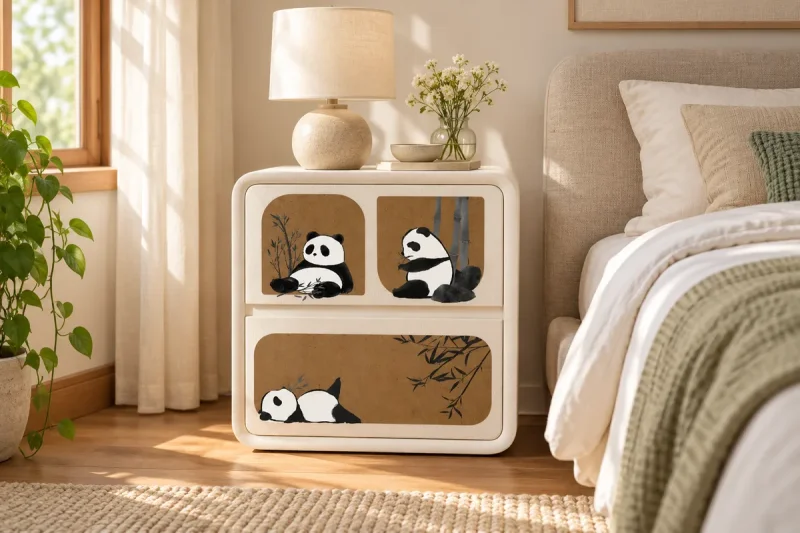
AI-assisted room illustration based on the ZG08 reference product. The room and styling are illustrative; the approved sample defines the supplied product and artwork.
Approve the front artwork as part of the product
The reference photograph shows two panda scenes in the upper front and a reclining panda scene below, framed by a rounded white cabinet body. For this model the artwork is a key part of the specification. Ask for a clear, straight-on image of the actual sample and agree the position, scale, colours and details of each panel before using the image in a catalogue.
Check how the artwork is applied and cleaned, and inspect its edges and alignment with the surrounding trim. Approve the repeatability and colour tolerance with the supplier rather than assuming that a screen image defines the finish. The supplied product should be checked against that approved physical sample. Confirm that any artwork used for a private-label programme is authorised for the agreed markets and channels.
The original photo shows two visible front sections. It does not establish the internal layout, opening mechanism or number of drawers. During sampling, open each section and measure its usable space; describe the actual arrangement in sales material only after it has been verified. For comparison, see the retro ZG08 decorative cabinet, which uses a different visual treatment and should be specified separately.
Choose a width for the room and for the design
The product data lists reference widths of 20, 25, 30, 35, 40, 45 and 50 cm, with D40 x H47 cm. Do not assume the layout of the panda panels remains identical at every width or that every width is immediately available. Request current dimensions and photos of the chosen version. Confirm whether the dimensions include trim and any projections, and measure the available width and depth alongside the bed.
A room plan should allow for the bed frame, nearby wall, skirting board and access to the cabinet's working sections. Compare the height with the mattress, considering whether the top surface remains comfortable to reach. For a retail programme, record the approved width as part of the SKU so the web listing, product label, assembly instructions and carton all describe the same item.
Assess the upholstery and construction on a real sample
The listed material is a fiberboard frame with a microfiber-leather upholstered exterior. Ask the supplier to specify the actual panel, upholstery and edge construction for the selected version; a photograph cannot verify thickness, grade or durability. Review the white finish under agreed lighting, paying attention to colour consistency, seams, corners and the transition between the soft exterior and decorated front.
Check the stability of the assembled unit on the intended floor surface and inspect all accessible edges and hardware. Operate every moving section several times and look for smooth movement and even alignment. Record the cleaning method recommended for the finish and artwork. Any load capacity or performance claim should be supported by the relevant sample test rather than estimated from the picture.
Turn the approved sample into a repeatable order
Ask for the sample to identify the selected width, white finish, front artwork, any handle or opening hardware, internal configuration and branding. Photograph the unit from the front, side and with its storage open. Keep the approved artwork file and the physical sample together with the specification, so the buyer, supplier and inspection team have one shared reference.
For packaging, agree how the rounded corners, upholstered surface and decorative panels will be protected against rubbing and compression. Confirm whether the item is supplied assembled, what protection is used inside the carton and how the selected size is labelled. Packing dimensions and shipment quantity should be calculated from the approved packed sample. The pre-shipment quality checklist can be adapted with artwork alignment, upholstery finish and access to each storage section.
Prepare an OEM or wholesale enquiry
Send the model reference SPF-ZG08-PANDA, destination market, intended use, selected width and planned quantity. Add the required artwork, finish, labels, carton method and any applicable documentation. Ask the supplier to confirm availability, minimum order quantity, sample cost and lead time for that exact combination; they are not fixed by the reference listing.
For a private-label discussion, the OEM and ODM enquiry page provides a route to review branding and packaging with the team. A clear brief helps buyers compare an actual approved design instead of treating an illustration as a complete specification.