Nightstand size has to work beside the bed before storage volume is considered. A deep cabinet may look useful in a drawing but feel heavy in a small room or block movement around the bed.
For export programs, the best size decision balances bedside proportion, drawer capacity, carton size, loading efficiency, and the buyer channel. If storage is the selling point, drawer count, runner grade, and packed weight should be decided together instead of increasing cabinet depth after the quotation is already built.
Size should match bed and room behavior
If storage is the main selling point, size should be tested through the drawer system rather than the outer cabinet alone. Compare the planned cabinet depth with current storage nightstands, then use the drawer runner guide to decide whether the added capacity will still feel smooth, stable, and export-safe.
Buyers should confirm width, depth, and height in centimeters before discussing appearance. A good-looking model can still fail if the drawer cannot open comfortably beside the bed.
Storage adds value and cost
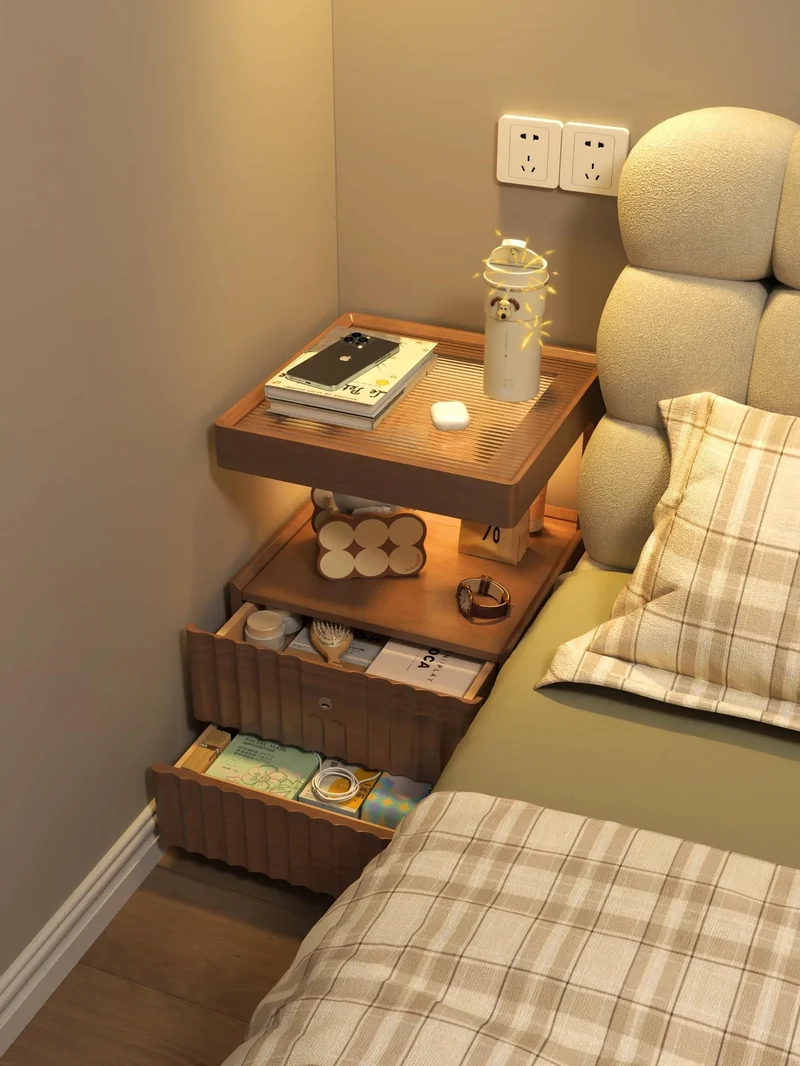
Every drawer adds runners, panels, handles, labor, and inspection points. Open shelves reduce structure and weight, but they create a more casual look. A smart-function compartment needs internal space and wire planning.
The buyer should decide whether customers want hidden storage, display space, charging access, or a compact bedside surface. Trying to include everything may raise cost and carton volume without improving sales.
Use carton volume as a design limit
Size decisions also affect packing. A slightly deeper cabinet may look better, but it can reduce container loading efficiency. For ecommerce, large cartons may increase local fulfillment cost.
Before approving a new size, ask for estimated carton dimensions and weight. This helps the buyer judge product value and landed cost together.
When storage becomes too much
A four-drawer cabinet may look useful, but it can become too heavy, too deep, or too expensive for a compact bedroom program. A one-drawer model with an open shelf may sell better if the channel values lighter cartons and simpler assembly.
The buyer should decide which items the user is expected to store: books, chargers, hotel menus, personal objects, or small electronics. Storage planning becomes easier when the expected use is concrete.
Storage Needs Should Be Defined by Use
A bedside cabinet for apartments may need one practical drawer and an open shelf. A hotel room may need a clean top and minimal hidden storage. A retail bedroom set may need more visual weight beside a larger bed. The same dimensions will not satisfy every channel.
Ask what the user will actually place inside the cabinet. Books, chargers, guest items, cosmetics, and small electronics all require different drawer depth and opening behavior.
When a Bigger Cabinet Becomes a Problem
A wider or deeper nightstand may look more valuable in a room render, but it also increases carton size and can reduce container loading efficiency. For online sellers, large carton dimensions can affect local delivery cost.
Before approving a bigger structure, compare the added storage value with the extra freight and packing cost. The best size is the one that sells well and ships predictably.
Choosing the first model
For a first order, it is often safer to adapt a proven size and adjust finish, handle, or function. A completely new structure is useful only when the buyer has a clear room requirement or a strong market reason.
Useful storage is not always maximum storage
A wide drawer is attractive in a showroom, but the customer may mainly need space for books, chargers, glasses, and small personal items. Too much depth can make the cabinet heavy and increase carton volume without improving daily use.
For apartments and compact bedrooms, an open shelf plus one drawer can feel lighter than two deep drawers. For hotel rooms, closed storage may be less important than a durable top and easy cleaning around the base.